

Be Greedy When Others Are Fearful
Warren Buffett famously said, “Be fearful when others are greedy, and be greedy only when others are fearful.” That sounds like very good advice, but it is hard to follow when markets are in turmoil. The emotion of fear tends to overcome everything else. Here, we examine historical market returns following periods of elevated volatility that support Mr. Buffett’s comment.
The CBOE Volatility Index (VIX) is known as Wall Street’s “fear gauge.” From a technical standpoint, the VIX measures the stock market’s expectation of 30-day volatility for the S&P 500 Index. The higher the VIX, the more volatility is expected in the near term.
VIX levels that reach 30, 35, or 40 typically coincide with sharp market sell-offs and heightened investor panic. As this is written on Friday morning, the stock market is down hard once again, and the VIX is around 30—which is considered a high level, as you would expect in the midst of a market decline.
The natural reaction is to be concerned—to be fearful. However, history tells a very different story. The table below, using data from 1990 forward, demonstrates a strong relationship between elevated market volatility, as measured by the VIX, and subsequent strong equity returns over 12- and 24-month horizons.
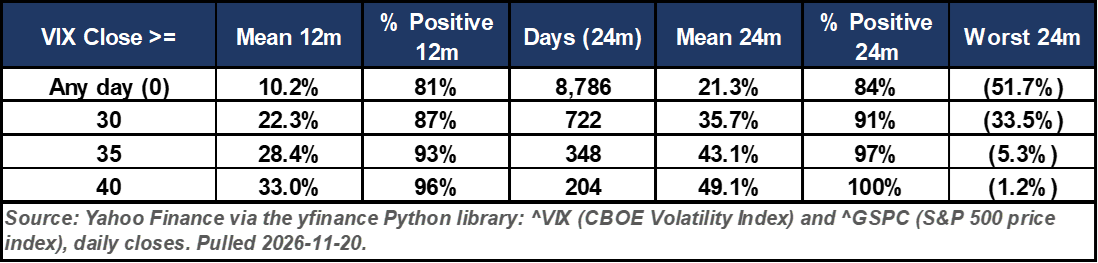
On an average day (the baseline), the average 12-month forward return is 10.2%, with an 81% win rate. When the VIX closes at 30 or higher, the average 12-month return more than doubles to 22.3%, and the win rate rises to 87%. The average 24-month return when the VIX is 30 or higher is 35.7%, with a 91% win rate. As the VIX rises, the mean forward returns accelerate dramatically, albeit not every time.
Don’t misunderstand—the market can still go down despite starting at a high VIX. However, drawdowns tend to be lower over a two-year window as volatility spikes. The worst 24-month return when the VIX is 30 or higher is -33.5%, as compared to -51.7% normally. When entering the market after the VIX reaches 35 or higher, the worst 24-month return was -5.3%.
The data provides no indication of when the decline might end, but it does tell you that buying when the VIX has the potential to be rewarding, and that selling when the VIX is high is likely a mistake.
Making Sense of the Anthropic IPO
With Anthropic (ANT) now trading on the public markets, the debate becomes more intense: Is the stock overvalued or undervalued?
A CNBC guest whom I can’t recall framed the debate quite well. He noted that Anthropic’s ultimate valuation comes down to a simple distinction: Will it become a service company or a product company?
If Anthropic remains primarily a service company—that is, selling computing tokens to other businesses—it risks becoming a commodity provider forced to compete on price. However, if it evolves into a product company, it will use its leading AI infrastructure to build high-value, proprietary solutions. As an example, Anthropic hired Nobel laureate John Jumper from Isomorphic Labs as part of Anthropic’s broader biotech expansion. Isomorphic Labs is Alphabet’s AI drug-discovery spinout that commercializes the AlphaFold breakthroughs Jumper and DeepMind co-founder Demis Hassabis developed. This could suggest that building a product powerhouse is Anthropic’s goal. If so, the upside is enormous, and the stock could be undervalued.
Still, we need to look closely at the numbers behind the current hype. As Anthropic is not yet profitable, price-to-sales relationships are appropriate. Many argue that at roughly 11x to 13x forward revenue, the company deserves a $1.5 trillion valuation, based on NVIDIA (NVDA), Microsoft (MSFT), and Alphabet (GOOG) selling at multiples of 6x to 9x forward revenue. It is worth pointing out one glaring difference: The peer companies being compared to Anthropic are already generating massive profits, whereas Anthropic is not—at least not yet.
Furthermore, while Anthropic’s growth is undeniably strong, it is showing signs of deceleration. Sequential revenue growth was a staggering 144% in the second quarter of 2026, before cooling to 47% in the third quarter. To be clear, 47% quarter-over-quarter growth is still out-of-the-park impressive, but it represents a sharp slowdown from Q2.
Part of that deceleration comes down to pricing pressure. Over the last few months, Anthropic has cut token prices across nearly its entire model lineup by 20% to 90%, depending on the tier. While improved computing efficiency helped make this possible, fierce competition from OpenAI, Google, and open-weight models like DeepSeek forced their hand—helping push the broader Silicon Data LLM Token Expenditure Index down more than 40% between late June and early October.
These steep price cuts on older model tiers highlight a major hurdle for maintaining breakneck revenue growth: Individual AI models only stay at the top of the heap for a very short time. The “my model is better than yours” merry-go-round isn’t stopping anytime soon. OpenAI, Google, Meta, and SpaceX have no intention of rolling over, and they will all have a major say in how this industry develops.
Finally, Anthropic’s successful debut puts enormous pressure on OpenAI to release a breakthrough model and finally go public itself. SpaceX was smart to get its IPO done early while market appetite was wide open. We believe OpenAI made a poor decision to postpone its own offering, though time will tell. Right now, the AI race is just as much a financial battle for capital as it is a technological battle for dominance.
Hang in there, this too will end!
What We’re Reading
- Trump vows to stop U.S. companies from building data centers abroad, threatens ‘tremendous tax’
- Anthropic was supposed to save the AI trade. What went wrong?
- A long-buried ancient library in Rome opens to the public after restoration
Palumbo Wealth Management (PWM) is a registered investment advisor. Advisory services are only offered to clients or prospective clients where PWM and its representatives are properly licensed or exempt from licensure. For additional information, please visit our website at www.palumbowm.com.
The information provided is for educational and informational purposes only and does not constitute investment advice and it should not be relied on as such. It should not be considered a solicitation to buy or an offer to sell a security. It does not take into account any investor’s particular investment objectives, strategies, tax status, or investment horizon. You should consult your attorney or tax advisor.
The views expressed in this commentary are subject to change based on market and other conditions. These documents may contain certain statements that may be deemed forward‐looking statements. Please note that any such statements are not guarantees of any future performance and actual results or developments may differ materially from those projected. Any projections, market outlooks, or estimates are based upon certain assumptions and should not be construed as indicative of actual events that will occur.
All information has been obtained from sources believed to be dependable, but its accuracy is not guaranteed. There is no representation or warranty as to the current accuracy, reliability, or completeness of, nor liability for, decisions based on such information and it should not be relied on as such.
All information has been obtained from sources believed to be dependable, but its accuracy is not guaranteed. There is no representation or warranty as to the current accuracy, reliability, or completeness of, nor liability for, decisions based on such information, and it should not be relied on as such.
The views expressed in this commentary are subject to change based on the market and other conditions. These documents may contain certain statements that may be deemed forward‐looking statements. Please note that no such statements are guarantees of any future performance, and actual results or developments may differ materially from those projected. Any projections, market outlooks, or estimates are based upon certain assumptions and should not be construed as indicative of actual events that will occur.
Past performance is no guarantee of future returns.
The analysis presented is for informational and educational purposes only and is based on historical market observations. The VIX reflects market expectations of near-term volatility and is not a reliable predictor of future market direction or investment returns. Historical returns following elevated VIX readings do not establish that similar results will occur in the future.
The analysis may include overlapping measurement periods and observations that are not statistically independent. Results may be sensitive to the selected time frame, VIX thresholds, calculation methodology and prevailing market conditions. Index returns do not reflect investment management fees, transaction costs or other expenses and are not representative of actual client account performance.
Investing during periods of heightened volatility involves substantial risk, including the possibility of continued market declines and significant loss of principal. Past performance does not guarantee future results. Investors should not rely on VIX levels alone when making investment decisions.
The discussion of Anthropic and other companies reflects opinions and analysis as of the publication date and is subject to change without notice. Statements concerning future revenue, growth, profitability, valuations, competitive positioning, initial public offerings and business strategies are forward-looking, involve assumptions and uncertainties, and may differ materially from actual outcomes.
References to individual securities are provided for informational purposes and should not be interpreted as personalized investment recommendations or guarantees of future performance. Investments in newly public companies and companies operating in emerging technologies may involve heightened volatility, uncertain profitability, significant capital requirements, competitive pressures and the risk of substantial or total loss.
Any valuation comparisons are dependent on assumptions and estimates that may prove inaccurate. Investors should evaluate the risks, financial circumstances and investment objectives relevant to their individual situations before making investment decisions.
Anthropic, Be Greedy When Others Are Fearful, fear gauge, S&P 500, S&P 500 returns, VIX, Warren BuffettBy: Adam
