

Swimming Upstream
The news this week turned sour. We, and many others, have warned that an extended conflict in Iran would bring worsening economic consequences with each passing day. In its May 2026 Oil Market Report, the International Energy Agency (IEA) reported that global oil supply declined by a further 1.8 mb/d in April to 95.1 mb/d. This brings total losses since February to 12.8 mb/d. The IEA concludes, “Our latest supply and demand estimates imply that the market will remain severely undersupplied through the end of 3Q26, even assuming the conflict ends by early June.” While “unprecedented” is an overused word, these observations truly fit the description, and the consequences are unpleasant.
Inflation also dominated the headlines. On Tuesday, the Bureau of Labor Statistics reported that annual inflation surged to 3.8% in April—a significant jump from 3.3% in March—primarily driven by a 50% spike in gasoline prices. Producer prices, were reported the next day and worsened the outlook. Final demand prices saw a hotter-than-expected preliminary increase of 1.4%, nearly triple what was forecasted. This translates to a 6.0% year-over-year jump. It is hard to deny that inflation is accelerating. While much of this is due to the Iran-Israel conflict, the longer this trend holds, the “stickier” inflation is likely to become.
This “hotter-than-expected” PPI print acted as the final catalyst for the bond market’s move above 5%. Investors view persistent wholesale inflation as a sign that price pressures are becoming pervasive rather than temporary. The bond market reacted quickly; the 30-year Treasury yield climbed to 5.04% immediately following the report as traders abandoned hopes for interest rate cuts in 2026.
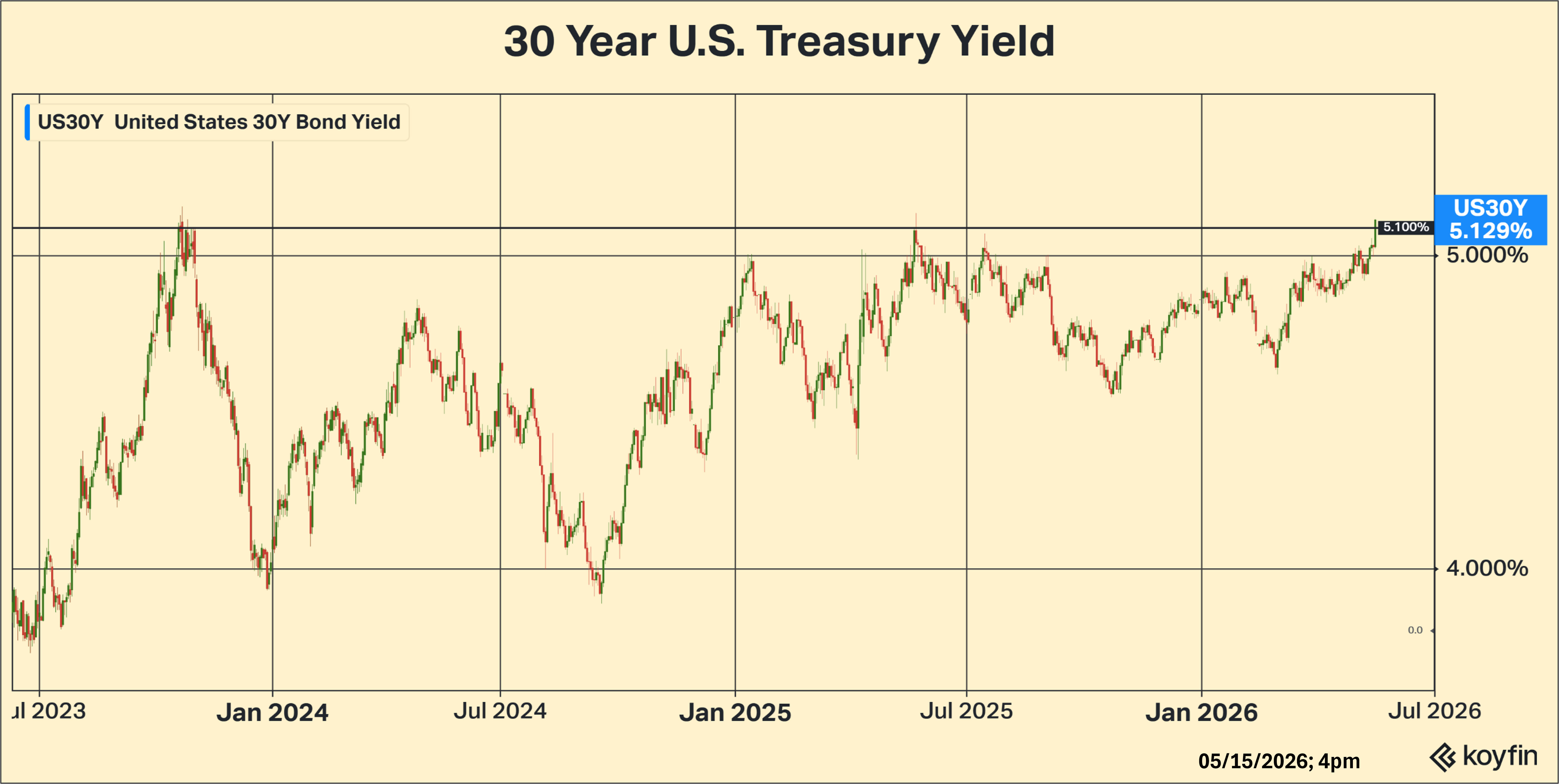
The stock market reversal on Friday is indicative that long rates holding above 5% present a substantial headwind for both the economy and the stock market. However, as shown in the chart above, the real breakout occurs around 5.1%, a level the market broached early on Friday and held throughout the day. From a technical perspective, the long bond holding above 5.1% would mark a regime change, breaking the previous 4% to 5% trading range.
Our read of the situation is that markets are losing faith that the Iran war will end soon. As a result, the inflationary impacts from the war are now being perceived as more permanent than temporary, placing upward pressure on interest rates. In that environment, long duration assets, like tech stocks, now look primed to take a breather. New Fed Chair Warsh has his work cut out for him. The case for lower interest rates this year has been effectively eliminated for now.
What can change that narrative is a quicker conclusion to the war. However, negotiations to open the Strait and remove the nuclear material are clearly not working as intended. The longer oil flows are restricted, the more likely the world will face global economic distress. The implication is that if this war is to end sooner rather than later, it will require a re-escalation – another hurdle for the stock market to overcome.
Have a great week!
What We’re Reading
-
Why Bernie Sanders Is Wrong About Gas Prices
-
Bill Ackman built Microsoft stake in first quarter during sell-off, betting on AI and cloud growth
-
Detroit automakers have cut more than 20,000 U.S. salaried jobs as AI threat looms
Palumbo Wealth Management (PWM) is a registered investment advisor. Advisory services are only offered to clients or prospective clients where PWM and its representatives are properly licensed or exempt from licensure. For additional information, please visit our website at www.palumbowm.com.
The information provided is for educational and informational purposes only and does not constitute investment advice and it should not be relied on as such. It should not be considered a solicitation to buy or an offer to sell a security. It does not take into account any investor’s particular investment objectives, strategies, tax status, or investment horizon. You should consult your attorney or tax advisor.
The views expressed in this commentary are subject to change based on market and other conditions. These documents may contain certain statements that may be deemed forward‐looking statements. Please note that any such statements are not guarantees of any future performance and actual results or developments may differ materially from those projected. Any projections, market outlooks, or estimates are based upon certain assumptions and should not be construed as indicative of actual events that will occur.
All information has been obtained from sources believed to be dependable, but its accuracy is not guaranteed. There is no representation or warranty as to the current accuracy, reliability, or completeness of, nor liability for, decisions based on such information and it should not be relied on as such.
All information has been obtained from sources believed to be dependable, but its accuracy is not guaranteed. There is no representation or warranty as to the current accuracy, reliability, or completeness of, nor liability for, decisions based on such information, and it should not be relied on as such.
The views expressed in this commentary are subject to change based on the market and other conditions. These documents may contain certain statements that may be deemed forward‐looking statements. Please note that no such statements are guarantees of any future performance, and actual results or developments may differ materially from those projected. Any projections, market outlooks, or estimates are based upon certain assumptions and should not be construed as indicative of actual events that will occur.
Past performance is no guarantee of future returns.
By: Adam
