You Can Never Go Home Again
Our title this week shares the name of Thomas Wolfe’s 1940 posthumously published novel. It carries a universal theme: time always marches forward, never backward. You can never go back home. The Middle East may be facing such a moment. War is not new or different in the Middle East; it has been a hotbed of conflict for centuries and has been alternately engulfed by Russian and U.S. military forces in long, drawn-out altercations for decades. Despite Shia-Sunni friction, the Arab world was generally aligned. Yet this time, Iran may have “crossed the line,” as something fundamental appears to have changed. We suggest that the Middle East may never return to the way it was.
- Iran is now isolated from most of the Arab world. Iran had already become a pariah state by the time the war started. Iran’s decision to fire missiles and drones at its Arab neighbors was the last straw and appears to have permanently altered the Middle Eastern landscape. The past tolerance for strained inter-Arab relations now appears to be dissolving; lines are being drawn. This week, we saw that Kuwait and Saudi Arabia have reopened their airspace and bases to the U.S. military. (Be careful: round two of Operation Epic Fury may be about to begin.)
- The UAE pulled out of OPEC. The United Arab Emirates officially withdrew from OPEC, freeing up its energy decisions to be based solely on the policy of the Emirates.
- The Abraham Accords. Despite Israel’s aggressive participation in the war, the Abraham Accords have been remarkably resilient, albeit not without strains.
While Iran has been chanting “Death to America” since the fall of the Shah in 1979, recent Iranian attacks on its Arab neighbors demonstrate that the Iranian nuclear issue is not uniquely a U.S. problem. As nuclear capability drew nearer, Iran’s Arab neighbors quickly realized they have no desire to be subservient to a nuclear Iran. As enrichment progressed, the political dynamics began to shift based on the theory that “the enemy of my enemy is my friend.”
For better or worse, President Trump has chosen to address the problem now, and he is staring at a fundamental dilemma. Leave Iran with its enriched uranium and he leaves defeated, with Iran’s nuclear capability intact. It is difficult to imagine that this would not be a crushing blow to the GOP in the midterms. The President’s optimal outcome is to emerge as the victorious warrior with the uranium stockpile secured. With the Iran problem solved, he would expect a rapid bounce in popularity. We have seen many “TACO Tuesdays,” but at this point, we think it is extremely difficult for Trump to pull out without the uranium. That implies a reasonable chance that Epic Fury is revived, despite the talk of a settlement that was rampant most of the week—though signs of re-escalation were evident on Friday.
Long-Term Ramifications
As opaque as the short-term story is, the longer term now appears clearer. Recall that COVID-19 altered (and is still changing) global supply chains. The realization that we were reliant on China for many critical goods resulted in a shift away from prioritizing low-cost Chinese operations toward prioritizing security of supply.
This week, we came across a post on X written by James Thorne, Chief Market Strategist of Wellington-Altus, titled “Iran’s Historic Mistake”. Mr. Thorne makes a similar observation: Arab states are confronting the realization that their oil and gas distribution lines are highly dependent on safe passage through the Strait of Hormuz and are therefore subject to the whims of Iran. It appears even Iran’s neighbors have decided “enough is enough” and are quickly altering the energy distribution chain. The stock market’s rally over the past few weeks may well be sniffing out the change that could be coming.
We used AI to generate the following summary of his comments (his full commentary is available at the link above):
Operation Epic Fury represents a strategic application of Clausewitz’s principle that war serves political ends. Rather than falling into the trap of nation-building, the Trump administration used decisive force to halt Iran’s nuclear progress and restore deterrence. This shift signaled a move away from restrained diplomacy toward a “peace through strength” doctrine that prioritizes clear results over endless occupation.
Iran’s attempt to weaponize the Strait of Hormuz backfired by exposing the extreme vulnerability of energy-importing powers. China, Europe, and Britain found their industrial stability threatened by the disruption of maritime chokepoints, proving that economic scale cannot compensate for a lack of resource security. This “Hormuz shock” has forced these nations to confront a world where hard power and geography dictate survival.
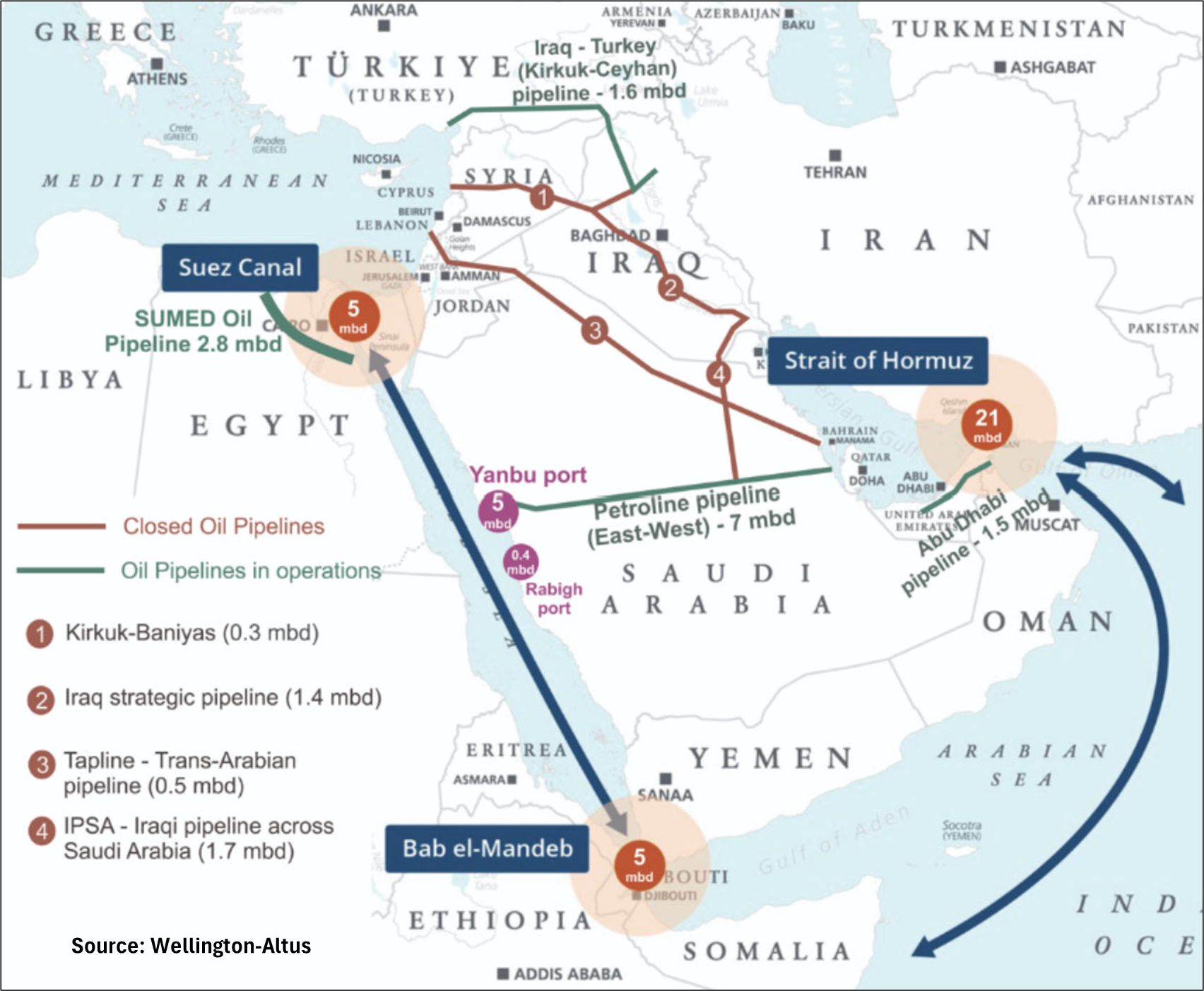
In response to this instability, the global energy order is undergoing a structural transformation. New corridors and pipelines are being planned to bypass unreliable chokepoints (see map above), while the UAE’s departure from OPEC signals the breakdown of traditional cartels. These shifts demonstrate that once a vital transit route becomes structurally unreliable, the world simply builds around it to find security elsewhere.
The political dynamic that has defined the years since the fall of the Shah may be on the brink of ending—if the President has the stomach for it. Change is unchanging. You can never go home again.
Have a great week!
What We’re Reading
-
Hiring Jumps by 115K. Why That Number Isn’t as Good as It Looks.
-
Micron surges more than 30% on week as memory chip rally goes parabolic
-
Michael Burry says the market today feels like ‘the last months of the 1999-2000 bubble’
Palumbo Wealth Management (PWM) is a registered investment advisor. Advisory services are only offered to clients or prospective clients where PWM and its representatives are properly licensed or exempt from licensure. For additional information, please visit our website at www.palumbowm.com.
The information provided is for educational and informational purposes only and does not constitute investment advice and it should not be relied on as such. It should not be considered a solicitation to buy or an offer to sell a security. It does not take into account any investor’s particular investment objectives, strategies, tax status, or investment horizon. You should consult your attorney or tax advisor.
The views expressed in this commentary are subject to change based on market and other conditions. These documents may contain certain statements that may be deemed forward‐looking statements. Please note that any such statements are not guarantees of any future performance and actual results or developments may differ materially from those projected. Any projections, market outlooks, or estimates are based upon certain assumptions and should not be construed as indicative of actual events that will occur.
All information has been obtained from sources believed to be dependable, but its accuracy is not guaranteed. There is no representation or warranty as to the current accuracy, reliability, or completeness of, nor liability for, decisions based on such information and it should not be relied on as such.
All information has been obtained from sources believed to be dependable, but its accuracy is not guaranteed. There is no representation or warranty as to the current accuracy, reliability, or completeness of, nor liability for, decisions based on such information, and it should not be relied on as such.
The views expressed in this commentary are subject to change based on the market and other conditions. These documents may contain certain statements that may be deemed forward‐looking statements. Please note that no such statements are guarantees of any future performance, and actual results or developments may differ materially from those projected. Any projections, market outlooks, or estimates are based upon certain assumptions and should not be construed as indicative of actual events that will occur.
Past performance is no guarantee of future returns.
Iran, Iran War, Iranian Nuclear Deal, middle east, middle east oil, OPEC
By: Adam
