

Meet Your New Digital Chief of Staff: Meta’s Muse
Meta’s Muse, introduced in September, aims to bring AI agents to the masses. With some minor revisions, here’s is what Google AI says it can do for you.
The era of the simple AI chatbot conversations is giving way to something entirely new: the era of the personal AI agent. Released in September, Meta’s Muse represents a major shift from conversational tools to agentic software. While traditional AI excels at generating answers, text summaries, or ideas, Muse is an assistant that can actually act on plain-language instructions and execute multi-step tasks across the internet and connected applications on your behalf.
Powered by the Muse Spark model, the agent runs within its own secure, isolated cloud-based virtual machine (Muse Secure VM). This environment provides Muse with its own browser and file system, allowing it to safely work through online research, fill out forms, and handle digital errands even after you close the application. Available to adults in the U.S. across iOS, Android, muse.ai, and WhatsApp, the tool is designed to significantly reduce the administrative friction between deciding to do something and actually getting it done.
Every day Personal Uses: From Answers to Action
Rather than asking a traditional chatbot, “What are good Italian restaurants near me?” Muse allows you to ask, “Find a highly rated Italian restaurant near the theater, check availability for 7:30 p.m., and show me the best reservation options.”
By offloading routine digital work while keeping you in control of consequential decisions, individuals are leveraging Muse across several core areas of daily life:
-
- Inbox and Calendar Management: Muse can review your inbox to identify important emails, flag unpaid bills, summarize long threads, and cross-reference messages with your calendar to prepare a daily digest or book appointments.
- Travel Planning: The agent can assemble comprehensive itineraries, identify travel dates from your inbox, research flights and lodging, and organize packing schedules. In tests, it has even gathered the extensive background history needed to fill out a Global Entry application.
- Household Administration & Customer Service: Muse can order groceries, manage product returns, and navigate automated customer-service channels. Reviewers have successfully used it to handle forgotten subscriptions, negotiate internet bills, secure refunds, and track down unpaid parking tickets.
- Social Coordination: When planning with friends, Muse can compare schedules, suggest venues, draft messages, and create shared planning documents.
- Personal Finance Organization: With limited access, Muse helps categorize spending, surface recurring charges, and track savings goals. To protect privacy, users can upload specific, downloaded account statements for analysis rather than granting broad, direct access to financial institutions.
Crushing Long-Term Objectives with “Goals”
One of Muse’s structural differentiators is its dedicated Goals tab. Instead of providing a one-time answer, Muse turns broad intentions into ongoing, dynamic plans that coordinate your time and resources over weeks or months.
Consider a practical example like preparing to move apartments on November 1. Instead of managing separate checklists, emails, and open browser tabs, a user can instruct Muse:
“Make a weekly packing plan, identify address changes I need to complete, compare internet providers at the new address, draft emails to my utility companies, and find moving boxes within 10 miles.”
Muse will map this out into a living project schedule, tracking loose ends and checking back in with you silently in the background as dates approach or schedules shift.
Smart Shopping and Masked Payments
Meta is pitching Muse heavily as a digital shopping companion. By combining web browsing with a Secure Credentials Store, the agent allows individuals to set precise requirements—such as budget, preferred brands, delivery dates, or specific product features—and compare options across the web.
-
- Price Tracking Dashboards: Muse can monitor retail items across the internet every morning and ping you only when an item hits a specific target discount.
- Secure Purchases: When you authorize Muse to complete a purchase, it processes payments via a wallet integrated with Link by Stripe. Rather than exposing your actual banking information, the wallet generates a single-use virtual card number, keeping your financial data hidden from both the merchant and the underlying AI model.
Customizing Your Agent’s “Soul”
Unlike generic AI systems with fixed personalities, Muse allows for deep aesthetic and behavioral customization through a file the interface calls its Soul. Users can change the agent’s name, dictate its tone, and completely redesign its visual mascot avatar. Early users have customized their agents to look and type like professional, high-energy managers who actively seek out opportunities on their own or tailored them to match a specific creative style.
Where Caution Matters: Safety and Boundaries
The convenience of an AI agent depends entirely on access. Because Muse requires sensitive data to interact with third-party services, privacy and security must be treated as central to its use. Media reviews note that data shared with Muse can technically be shared with Meta, meaning users must maintain strict oversight.
When configuring your agent, security experts recommend applying a strict “least access” rule:
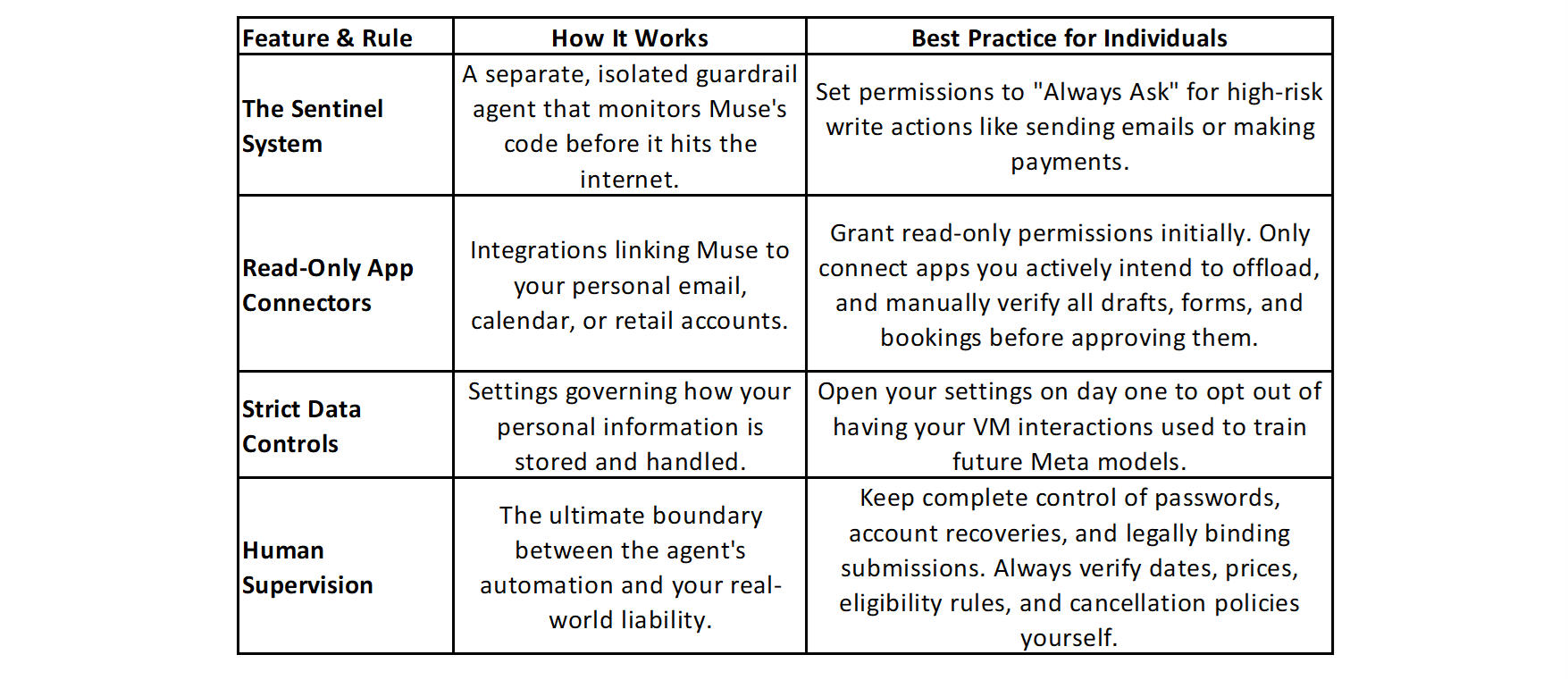
Ultimately, Muse functions best when treated like a capable but brand-new coworker. It is not designed to replace your judgment, but rather to eliminate the dozens of small, tedious administrative steps that clutter daily life. By setting clear boundaries around permissions and approvals, individuals can gain meaningful time back while keeping the decisions that matter firmly their own.
(PWM Note: Others are expressing privacy concerns with Muse: See the story in “What We’re Reading” below.)
Access and Affordability: The Free Tier & Pricing Breakdown
Unlike many premium AI utilities on the market, Meta has designed Muse around a permanent free-to-use tier rather than a time-limited free trial. To balance operational compute costs, Meta segments its consumer pricing dynamically based on weekly token allocation.
The consumer subscription model scales across three tiers:
-
- The Permanent Free Tier: Costing $0/month, this tier includes an allowance of 100 million tokens per week. For the vast majority of casual users, this data bucket is generous enough that a normal week of handling routine digital errands will not exhaust it. (Note: A valid payment card is still required at signup for identity and age verification, though the card is not charged unless you choose to upgrade).
- The Power Tier: Costing $20 per month, this tier raises your bucket to 500 million Muse tokens per week—designed for individuals running the agent to manage heavy, interconnected personal workflows.
- The Maximum Tier: Costing $100 per month, this tier bumps the limit to 3 billion Muse tokens per week for high-end power users who leave the agent working unattended for hours at a time.
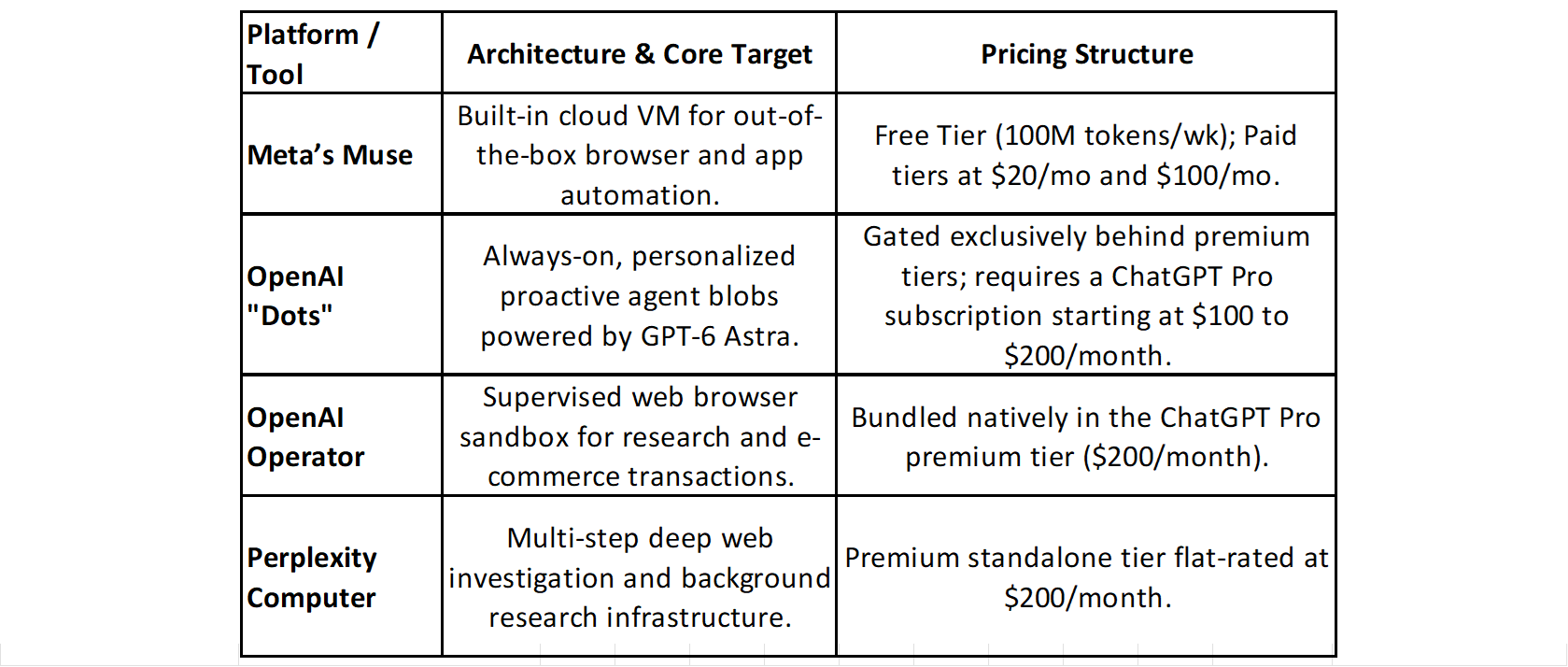
Cost Comparison
To anchor its market position, Meta is aggressively undercutting the broader AI landscape to win consumer adoption.
Have a great week. If you have any questions, have your Muse agent contact us!
What We’re Reading
-
Labor market faltered in September as jobs increased by just 29,000
-
Meta’s Muse Is Misbehaving in Mysterious Ways With Your Privacy
-
Is Another Eurozone Debt Crisis Looming?
-
France’s fresh budget battle threatens to topple another government
Palumbo Wealth Management (PWM) is a registered investment advisor. Advisory services are only offered to clients or prospective clients where PWM and its representatives are properly licensed or exempt from licensure. For additional information, please visit our website at www.palumbowm.com.
The information provided is for educational and informational purposes only and does not constitute investment advice and it should not be relied on as such. It should not be considered a solicitation to buy or an offer to sell a security. It does not take into account any investor’s particular investment objectives, strategies, tax status, or investment horizon. You should consult your attorney or tax advisor.
The views expressed in this commentary are subject to change based on market and other conditions. These documents may contain certain statements that may be deemed forward‐looking statements. Please note that any such statements are not guarantees of any future performance and actual results or developments may differ materially from those projected. Any projections, market outlooks, or estimates are based upon certain assumptions and should not be construed as indicative of actual events that will occur.
All information has been obtained from sources believed to be dependable, but its accuracy is not guaranteed. There is no representation or warranty as to the current accuracy, reliability, or completeness of, nor liability for, decisions based on such information and it should not be relied on as such.
All information has been obtained from sources believed to be dependable, but its accuracy is not guaranteed. There is no representation or warranty as to the current accuracy, reliability, or completeness of, nor liability for, decisions based on such information, and it should not be relied on as such.
The views expressed in this commentary are subject to change based on the market and other conditions. These documents may contain certain statements that may be deemed forward‐looking statements. Please note that no such statements are guarantees of any future performance, and actual results or developments may differ materially from those projected. Any projections, market outlooks, or estimates are based upon certain assumptions and should not be construed as indicative of actual events that will occur.
Past performance is no guarantee of future returns.
By: Adam
