

Is the AI Debt Tsunami Hitting the Yield Wall?
The Iran war looks unsolvable, and the risk is higher oil prices for longer, bringing inflation concerns back into the picture. With the exception of Microsoft, the mega-tech companies are now free cash flow negative due to the still accelerating spend on AI infrastructure, and they are layering on debt at an unprecedented pace to do it. That has interest rates rising, which appears likely to be a continuing challenge to the stock market. Without a change in this outlook, equity returns appear likely to be muted.
The recent surge has long-term interest rates breaking out of an upward-sloping channel (see chart below), driven by resilient economic data, sticky inflation, a continuing geopolitical energy shock, and an unexpected hawkish tilt at the Federal Reserve under new Chair Kevin Warsh. The sharp upward shift in rates is beginning to rattle global financial markets, pressuring valuations and pushing 30-year mortgage rates above 6.75% this week. Rates are also creating ripples, if not waves, during one of the largest corporate debt cycles in modern history: the race to finance artificial intelligence infrastructure.
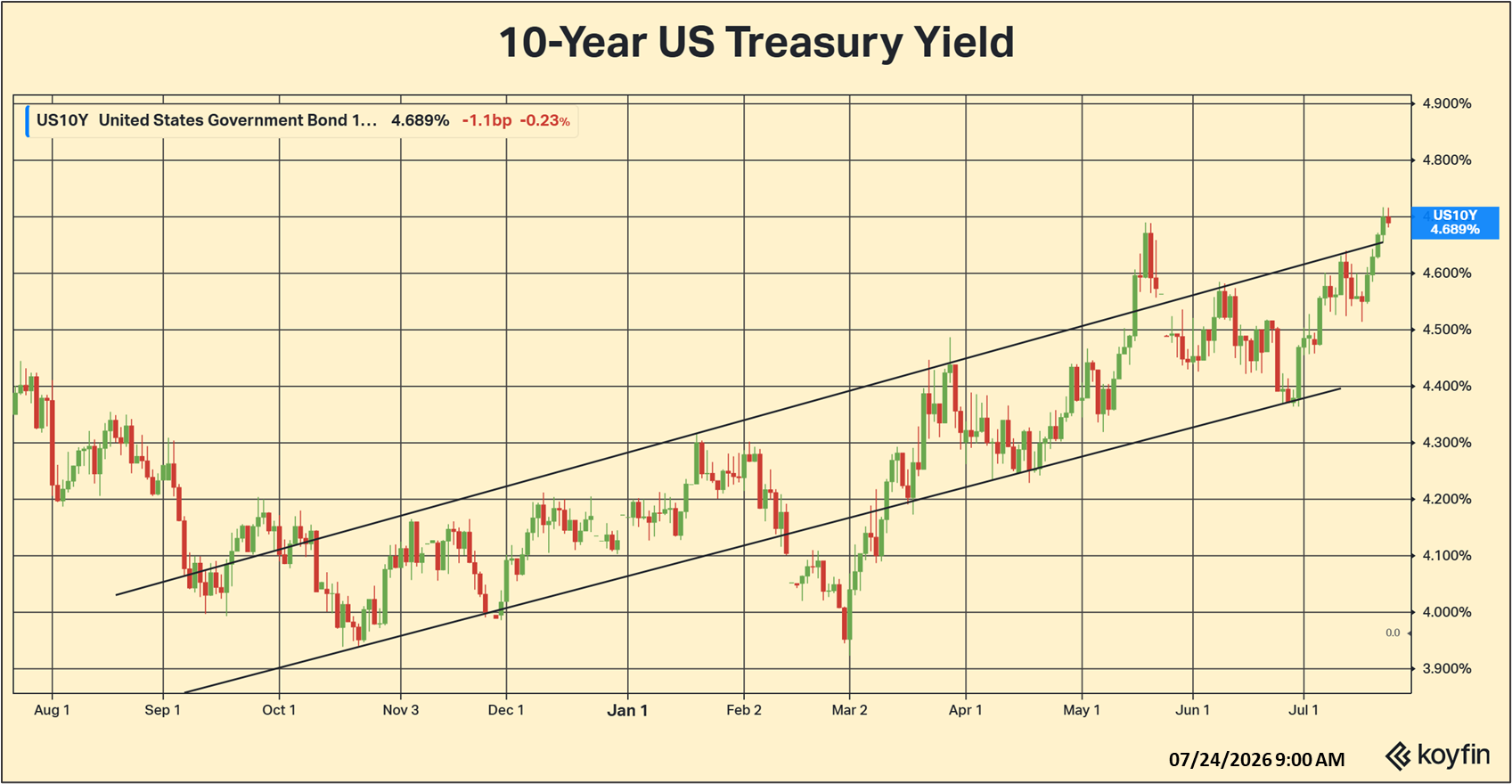
Why Long-Term Rates Are Rising
The primary catalysts behind the recent rise in longer-dated bond yields include:
- Sticky Inflation: Another spike in crude oil prices—rebounding past $90 due to ongoing Middle East conflicts—will add inflationary pressure in the coming months.
- A Hawkish-Leaning Federal Reserve: Wall Street has been forced to scrap its interest-rate cut narrative. As of Friday morning, the CME Fed Watch Tool shows the most probable scenario as including two rate hikes by January 2027 (shown below).

- Debt Supply Shock: Oil is not the only market experiencing a supply shock. Debt markets are experiencing a different supply shock… too much supply. Issuance by technology giants is growing rapidly, physically pushing up term premiums and reshaping the structure of the fixed-income market.
Financing the AI Capex Boom with Debt
Hyperscaler capital expenditures are projected at $650 – $800 billion this year and in excess of $1 trillion in 2027. Historically, mega-cap tech giants funded operations through massive piles of cash. However, the sheer scale of the AI arms race has virtually eaten up all of the free cash flow of the hyperscalers and is driving a large and rapid shift toward debt financing. According to Morgan Stanley, high-grade AI debt supply this year reached $270 billion by early July, which is more than double the total for 2025.
This enormous supply allows bond buyers to be more selective, putting them in a position to command higher rates, which we believe is a contributor to the recent rise in interest rates.
The Emerging Risks to Capital Spending
While these technology behemoths still maintain fundamentally solid credit profiles, the widening gap between immediate capital expenditure and delayed monetization creates risks to AI capital spending. If enterprise AI adoption or software revenue growth fails to scale fast enough to match the debt service requirements, credit default swap spreads and credit spreads will continue to widen and potentially prompt a slowdown in the global computing buildout.
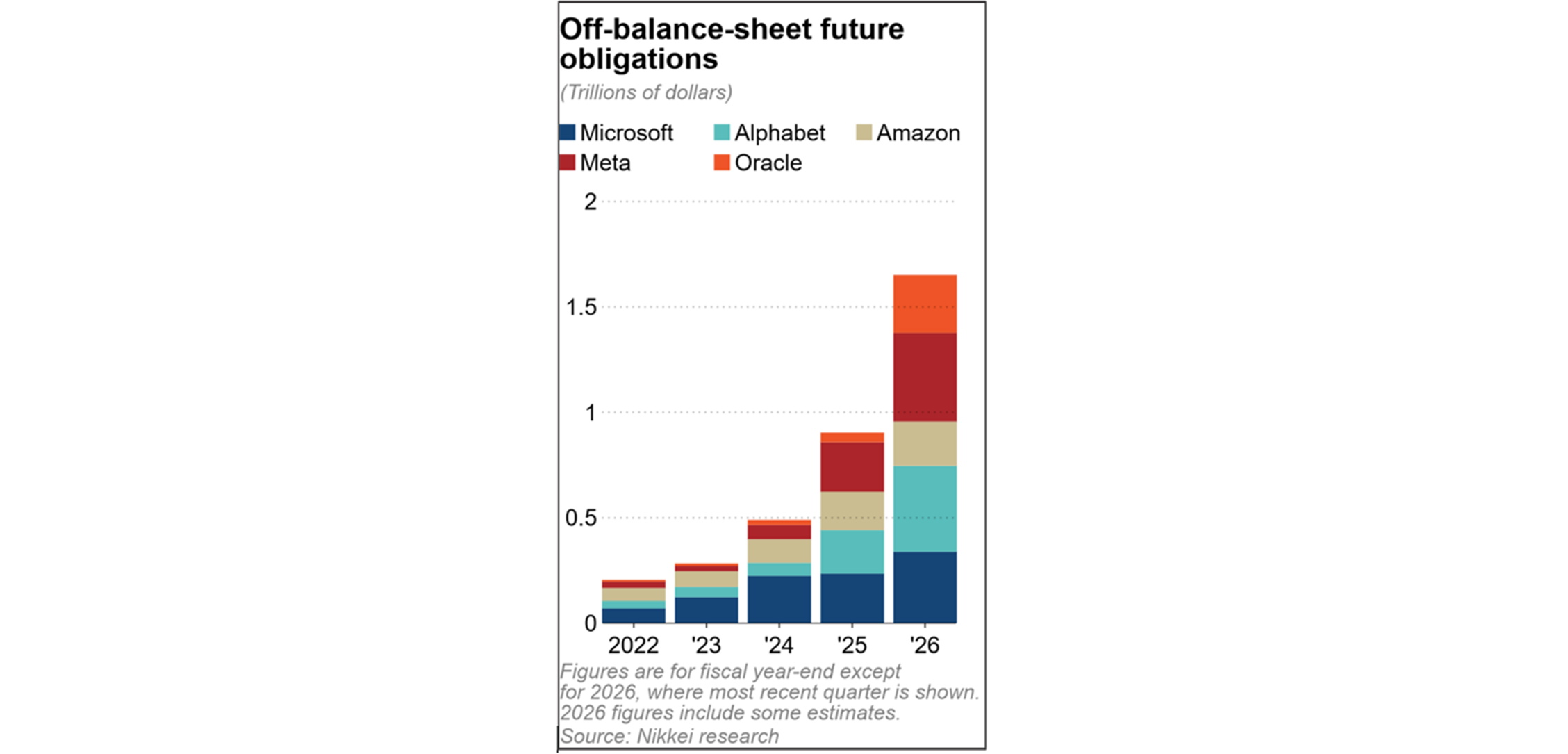
Complicating the situation is the increasing use of off-balance-sheet financing for these projects. A story this week on Nikkei Asia reported that tech giants off-balance-sheet debt has swelled to $1.65 trillion. This hidden debt is the result of many complicated structures, including sale/leasebacks. These are transactions where a company sells an asset it owns (such as a datacenter) to an infrastructure fund, or other investor, and simultaneously leases it back under a long-term agreement. This removes debt from the seller’s balance sheet and replaces it with a lease liability that is the effective equivalent of debt.
This type of activity makes traditional metrics, like debt-to-equity ratios, look healthier than they actually are. Long-term lease commitments function exactly like debt payments.
The Broader Impact of Higher Rates on Financial Markets
The combination of higher rates and shifting macroeconomic fundamentals is changing the investment landscape:
- Equity Market Headwinds: The realization that rates may stay higher for longer is beginning to pressure equity valuations.
- Spread Fatigue: While corporate credit spreads (the difference between Treasury yields and other bond yields) remain historically tight, investors are showing “spread fatigue”. Falling bond coverage ratios indicate that buyers are starting to demand higher yields to absorb the historic wave of incoming supply.
Thus far, second quarter earnings reports have generally been strong, but the headwind of rising rates is holding back stocks for the time being.
Have a great week!
What We’re Reading
-
AI data center boom ‘stress tests’ insurers as private capital floods in
-
DNA from the skull of an unknown Revolutionary War soldier reveals more than his name
-
Shortsighted stock market can no longer brush off war: ‘It’s too hard to ignore $100 oil’
Palumbo Wealth Management (PWM) is a registered investment advisor. Advisory services are only offered to clients or prospective clients where PWM and its representatives are properly licensed or exempt from licensure. For additional information, please visit our website at www.palumbowm.com.
The information provided is for educational and informational purposes only and does not constitute investment advice and it should not be relied on as such. It should not be considered a solicitation to buy or an offer to sell a security. It does not take into account any investor’s particular investment objectives, strategies, tax status, or investment horizon. You should consult your attorney or tax advisor.
The views expressed in this commentary are subject to change based on market and other conditions. These documents may contain certain statements that may be deemed forward‐looking statements. Please note that any such statements are not guarantees of any future performance and actual results or developments may differ materially from those projected. Any projections, market outlooks, or estimates are based upon certain assumptions and should not be construed as indicative of actual events that will occur.
All information has been obtained from sources believed to be dependable, but its accuracy is not guaranteed. There is no representation or warranty as to the current accuracy, reliability, or completeness of, nor liability for, decisions based on such information and it should not be relied on as such.
All information has been obtained from sources believed to be dependable, but its accuracy is not guaranteed. There is no representation or warranty as to the current accuracy, reliability, or completeness of, nor liability for, decisions based on such information, and it should not be relied on as such.
The views expressed in this commentary are subject to change based on the market and other conditions. These documents may contain certain statements that may be deemed forward‐looking statements. Please note that no such statements are guarantees of any future performance, and actual results or developments may differ materially from those projected. Any projections, market outlooks, or estimates are based upon certain assumptions and should not be construed as indicative of actual events that will occur.
Past performance is no guarantee of future returns.
datacenter financing, datacenters, debt issuance, Federal Reserve, hyperscalers, hyperscalers capex, Inflation, Kevin WarshBy: Adam
